End-of-life device waste usually looks like a disposal problem.
By the time a business sees old laptops in storage, damaged handhelds in drawers, outdated printers in a back room, or mixed accessories piled into boxes, the waste has already built up. The pickup stage is visible, but the real issue often started much earlier.
It usually starts in the gap between procurement and IT.
Devices are bought without a clear lifecycle plan. Accessories are ordered without tracking. Different teams buy different models for similar roles. Refreshes happen without enough preparation. Working spares and retired equipment get mixed together. Chargers, docks, and cables become separated from the devices they belong to and disappear into general storage. Over time, the business ends up with more retired electronics, more confusion, and more waste at the end of the process than it expected.
That is why reducing end-of-life device waste is not only about what happens at disposal.
It is also about what procurement and IT do before devices ever reach that stage.
This guide is for UAE businesses that want a more practical way to reduce avoidable device waste by improving how procurement and IT work together from purchase to retirement.
Why this is a cross-functional problem
Procurement and IT influence different parts of the same lifecycle.
Procurement usually affects:
- what is bought
- how standardized the device fleet is
- whether accessories and peripherals are ordered in a controlled way
- whether replacements are planned or reactive
- whether vendors and product choices create unnecessary variety
IT usually affects:
- how devices are deployed
- how long they stay in service
- when they move into a working spare pool
- when they are formally retired
- how they are prepared for handover
- whether old and active equipment are kept separate
If these teams work in parallel but not together, device waste becomes harder to control.
The business may still have a disposal process at the end, but by then the upstream inefficiencies have already created a larger, messier batch than necessary.
What “reducing end-of-life device waste” actually means
This does not mean keeping every device forever.
It does not mean delaying retirement when equipment is genuinely obsolete, damaged, or no longer appropriate for business use.
It means reducing avoidable waste by improving the decisions that lead to retirement batches.
In practice, that usually means:
- buying more consistently
- planning refreshes earlier
- defining what counts as a working spare
- avoiding mixed and incomplete device batches
- keeping devices with their related accessories where practical
- reducing duplicate orders and uncontrolled replacements
- making retirement decisions clearer and earlier
The result is not “less disposal at any cost.”
The result is a cleaner, more deliberate lifecycle.
Where avoidable device waste usually begins
Most businesses do not create extra device waste through one big mistake. They create it through small habits that accumulate over time.
Common examples:
- ordering mixed models for similar users or sites
- buying replacement devices before the old fleet is clearly reviewed
- holding outdated equipment indefinitely because no one defines its status
- separating chargers, docks, adapters, and accessories from the core device
- keeping damaged devices in general storage rather than moving them into a controlled retirement path
- allowing each branch or department to manage old equipment differently
- treating refreshes as a deployment project only, rather than a deployment-and-retirement project
These are not always obvious at the time. But they show up clearly at the end of the lifecycle.
What procurement and IT should be trying to achieve together
A good joint approach should help the business do five things better:
- standardize what it buys
- reduce unnecessary device variety
- define asset status earlier
- prevent complete items from turning into incomplete waste
- move retired equipment into a controlled path before it becomes a storage problem
If procurement and IT align on those five areas, end-of-life waste becomes easier to reduce before disposal even enters the picture.
The practical workflow procurement and IT teams can use
1) Set one shared lifecycle standard
The first step is to stop treating procurement and retirement as separate conversations.
Procurement and IT should agree on a basic lifecycle standard that answers:
- what categories are being managed
- what the normal device lifespan looks like internally
- when equipment should be reviewed
- what qualifies as a working spare
- when a device moves into retirement
- who approves replacement and who confirms closeout
This does not need to be a complex policy. It just needs to be clear enough that both teams are working toward the same outcome.
Without that shared standard, one team buys while the other team stores, and the waste builds in the middle.
2) Standardize approved device families where practical
Unnecessary variety is one of the easiest ways to create lifecycle waste.
When similar users or sites operate completely different laptop models, docks, chargers, or peripherals, it becomes harder to:
- manage spares
- keep accessories matched to devices
- redeploy usable components internally
- plan refreshes cleanly
- stage retirement batches in an organized way
A more standardized fleet does not solve everything, but it reduces friction throughout the lifecycle.
This is especially useful for:
- office laptops and desktops
- docking setups
- monitors
- phones and tablets
- handheld or branch devices used across multiple sites
The goal is not to eliminate every variation. It is to avoid avoidable variation.
3) Buy with deployment and retirement in mind
Procurement decisions should not stop at delivery.
When a device category is approved, the business should already be thinking about:
- how the device will be tracked
- what accessories belong with it
- how replacement cycles will be managed
- what the expected end-of-life path will look like
- whether the device will create accessory confusion later if the setup is too fragmented
This matters because incomplete retirement batches often start at the buying stage.
If chargers, docks, adapters, cables, and related components are not treated as part of the device setup from the start, they are more likely to drift into general storage later.
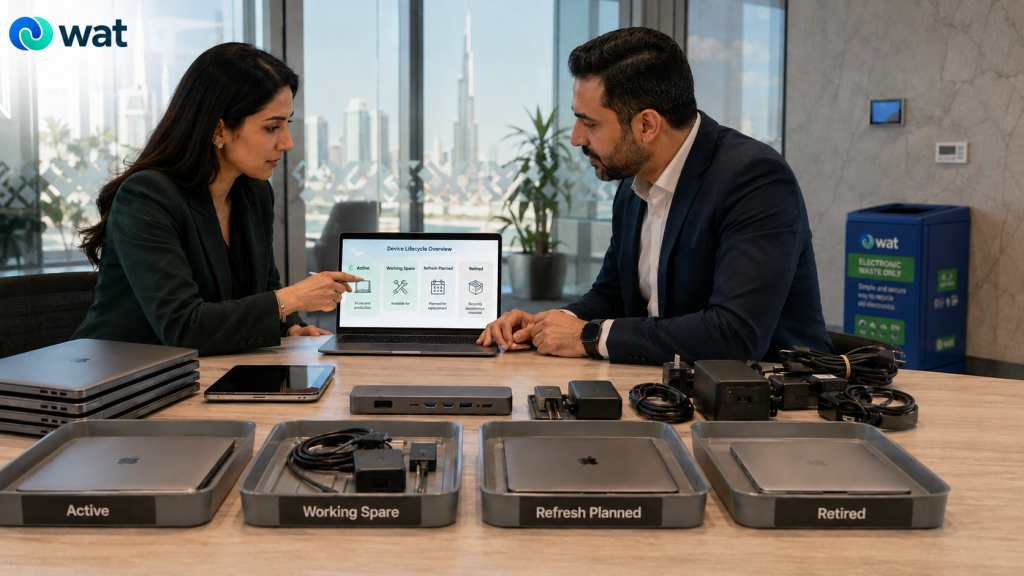
4) Define what counts as an active asset, a working spare, and a retired device
A lot of waste builds up because the business never clearly defines asset status.
Procurement and IT should use the same working definitions for:
- active device — approved for current business use
- working spare — intentionally kept for controlled replacement needs
- retired device — no longer approved for active use or spare use and ready for controlled handling
Without those distinctions, businesses often end up with a large grey zone of “maybe useful later” equipment sitting in storage indefinitely.
That is where end-of-life waste begins to accumulate.
5) Keep devices with their related accessories where practical
This is one of the simplest and most useful controls in the whole lifecycle.
When devices reach refresh or retirement, their related chargers, docks, adapters, power units, and other key accessories often get separated. Once that happens, they are easier to lose, harder to identify, and more likely to end up mixed into general storage or waste.
A practical rule is:
where devices have related accessories, keep them together wherever practical rather than separating them into mixed boxes or miscellaneous stock.
This helps the business keep better control of complete device sets and reduces the amount of accessory waste created by poor internal handling rather than real equipment failure.
6) Plan refreshes as two-sided projects
A lot of businesses plan the “new device rollout” carefully and treat the “old device retirement” as something to sort out later.
That creates unnecessary waste.
A better model is to treat every refresh as two linked tracks:
- deployment of the new equipment
- controlled retirement of the old equipment
That means procurement and IT should plan in advance:
- which assets are being replaced
- when they move out of active use
- where they will be staged
- how related accessories will be handled
- whether any devices require a defined data path
- when the retirement batch will be handed over
For a practical guide to the retirement side of refresh planning, see our blog:
Office IT Refresh in the UAE: A Practical Offboarding Checklist (Collect, Store, Erase, Handover).

7) Reduce “just in case” storage
One of the biggest drivers of end-of-life device waste is indefinite storage.
Old equipment is often kept because:
- no one has time to review it
- the site may need a spare later
- no one wants to make the retirement decision
- the devices are incomplete, so teams ignore them
- the batch is too mixed to handle cleanly
Procurement and IT can reduce this by reviewing stored equipment at defined intervals and asking:
- Is this still an approved working spare?
- Is this incomplete or damaged?
- Does this still belong in service planning?
- Should it now move into the retirement process?
That simple review prevents stored electronics from quietly becoming unmanaged waste.
8) Make the data-handling route part of lifecycle planning
For data-bearing devices, the end-of-life path should not be a last-minute decision.
Laptops, desktops, phones, tablets, servers, storage devices, and some other business equipment may require a defined downstream path such as:
- data sanitization
- hard disk shredding
- asset destruction
- another approved secure-handling route based on internal policy
If that decision is only made at the very end, retirement batches become slower, less consistent, and harder to plan.
When procurement and IT treat data-related handling as part of lifecycle planning, the transition from active use to final handover becomes much cleaner.
For a broader look at why these controls matter, see our blog:
Chain of Custody for Retired IT Assets in the UAE: Why Documentation Matters from Pickup to Final Processing.
9) Use one minimum record set for procurement and IT
Procurement and IT do not need separate parallel records for the same retirement batch.
A shared minimum record set usually works better.
At minimum, this can include:
- site or department
- device categories
- quantities
- condition notes where relevant
- status as active, working spare, or retired
- notes for damaged or battery-containing items
- handover or transfer date
- batch reference if used internally
This makes it easier to review patterns over time and easier to reduce unnecessary waste in future cycles.
10) Review what is repeatedly becoming waste
A strong lifecycle process does not stop at one collection.
After each refresh, cleanup, or retirement cycle, procurement and IT should review:
- which categories are becoming waste most often
- which sites are creating mixed or incomplete batches
- whether certain accessories are regularly getting lost
- whether non-standard purchases are increasing waste
- whether damaged devices are entering the stream too early or too late
- whether working spare rules are being applied consistently
That review is how the business reduces waste before the next cycle, not after.
What good cross-functional control looks like
A good result usually looks like this:
- procurement and IT use the same lifecycle definitions
- standard device families reduce unnecessary variety
- working spares are clearly defined
- accessories are kept with the related devices where practical
- refreshes include both deployment and retirement planning
- data-bearing devices follow a defined path
- incomplete or outdated equipment does not sit indefinitely in unmanaged storage
- retirement batches are cleaner and easier to handle
That is what reducing end-of-life waste looks like in practice.
Common mistakes teams can avoid
Treating disposal as the first time the business thinks about waste
By that stage, most of the waste problem has already formed.
Buying too many variations of the same type of device
Unnecessary variety often creates accessory mismatch, harder spare management, and more incomplete retirement batches.
Keeping uncertain equipment in indefinite storage
“Maybe useful later” often turns into unmanaged end-of-life waste.
Separating devices from their key accessories
This is one of the fastest ways to create avoidable waste and confusion.
Planning refreshes without planning retirement
A rollout-only mindset usually creates a messy back end.
Letting procurement and IT run separate lifecycle logic
The process becomes cleaner when both teams work from the same definitions and expectations.
FAQs
Why should procurement be involved in reducing device waste?
Because purchasing choices, standardization, and refresh planning have a direct effect on how much device waste builds up later.
Is this mainly an IT issue?
No. IT controls deployment and retirement, but procurement strongly influences the volume, consistency, and lifecycle pattern of the devices entering the business.
What is the biggest cause of unnecessary end-of-life device waste?
Usually a mix of poor standardization, unclear asset status, lost accessories, and delayed retirement decisions.
Should chargers, docks, and accessories be kept with the device?
Where practical, yes. Keeping related items together helps reduce loss, confusion, and unnecessary accessory waste.
How can a business reduce waste without delaying proper retirement?
By defining asset status clearly, reviewing stored equipment regularly, planning refreshes earlier, and moving genuinely retired devices into a controlled process instead of leaving them in unmanaged storage.
If your business wants to reduce end-of-life device waste through better planning between procurement and IT, we can help support a more controlled retirement process, from collection planning to secure downstream handling. Request a collection or contact WAT to discuss your next refresh or retirement cycle.