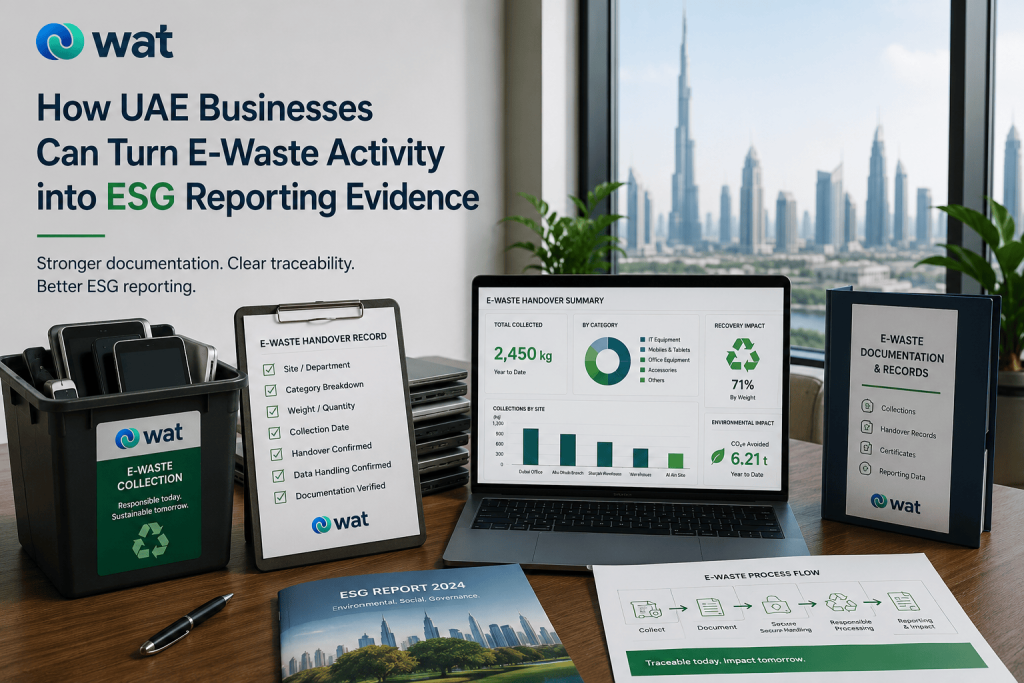
Many businesses already have e-waste activity.
They remove old laptops during refresh cycles. They retire printers after upgrades. They clear out storage rooms. They hand over damaged devices, old monitors, handheld scanners, cables, and branch electronics during cleanups or relocations.
But activity on its own is not the same as ESG evidence.
If a business cannot show what was collected, from which site, when it left the premises, how it was handled, and what records support that handover, then the activity remains operational. It may still be useful. It may still be responsible. But it is not yet strong reporting evidence.
That is the gap many organizations run into.
Sustainability and ESG reporting usually depend on being able to show that something happened in a consistent, traceable, and documented way. In the case of retired electronics, that means turning one-off pickups and cleanup projects into a repeatable evidence trail.
This guide is for UAE businesses that want to make their e-waste activity more useful for ESG reporting without turning the process into unnecessary paperwork.
Why e-waste activity often fails to become reporting evidence
The problem is usually not that the business did nothing.
The problem is that the supporting records are too weak, too inconsistent, or too scattered to be used confidently.
Common examples:
- one office keeps a pickup record, another does not
- categories are logged differently from one site to another
- the business remembers that “a lot of old devices were removed,” but not what the batch actually included
- damaged or battery-containing items were separated operationally, but not reflected in the records
- data-bearing devices followed a controlled path, but the reporting team never saw the documentation
- sustainability teams receive broad claims, but not enough usable detail
This is why ESG evidence needs more than a collection date.
It needs a simple structure behind the activity.
What counts as ESG evidence in practical terms
For most businesses, useful ESG evidence is not a long narrative. It is a clear record set that shows the activity happened in a controlled way.
For e-waste handling, that usually means being able to show:
- what categories were included
- which site or department the batch came from
- when the batch was collected or transferred
- whether the handover was controlled and documented
- whether any special categories were included, such as damaged or battery-containing devices
- whether data-bearing devices followed the required handling path
- whether the business can retrieve the records again later
This does not mean every organization needs the same reporting depth.
A single-site company may only need a simpler evidence trail. A multi-site company may need a more standardized format. But in both cases, the principle is the same: the evidence needs to be clear enough to support internal reporting, management review, or external sustainability communication.
Why this matters for ESG and sustainability teams
Retired electronics often sit between several internal functions.
- IT decides what is leaving service
- facilities or operations may manage staging and collection
- procurement or finance may care about asset status
- ESG or sustainability teams may need reporting evidence
- management may want proof that the process is controlled
Without coordination, each team sees only one part of the picture.
That is why e-waste reporting often stays weaker than it should be. The business may have done the work operationally, but it did not convert that work into a usable reporting trail.
A better process does not necessarily mean more paperwork. It usually means using the same minimum data points every time.
What businesses should be able to evidence
A good reporting-ready process should help the business answer questions like:
- Which sites participated in the collection?
- What categories of electronics were handed over?
- Was the batch handled through a defined process?
- Were any damaged or battery-related items included?
- Were data-bearing assets handled through the right downstream path?
- Are the supporting records easy to retrieve?
- Can the business compare one period, site, or batch against another?
If the answer to most of those questions is “not really,” then the activity is still happening operationally, but it is not yet strong ESG evidence.
The practical workflow businesses can use
1) Decide what you actually want to evidence
Before improving the records, decide what the business is trying to demonstrate.
For most UAE businesses, the goal is usually one or more of these:
- that retired electronics are being handed over through a controlled process
- that multiple sites are following the same handling rules
- that e-waste is not being left in unmanaged storage indefinitely
- that the organization is keeping usable records for sustainability or governance purposes
- that data-bearing assets follow the required handling route
- that e-waste activity can be summarized over time, not just remembered after the fact
This first step matters because evidence works best when it is linked to a clear reporting purpose.
2) Standardize the reporting fields before the next batch
If every site records something different, the business will struggle to use the information later.
A simple standardized format usually works best.
At minimum, record:
- site name
- department, branch, or area where relevant
- collection or transfer date
- device categories
- quantities
- notes for damaged items
- notes for battery-containing items
- notes for data-bearing categories where relevant
- releasing contact
- receiving party
- batch reference if used internally
This does not need to be complicated. It just needs to be consistent.
If the e-waste disposal company is using a digital record-tracking and reporting software or platform, like WAT’s proprietary e-waste management system, this process becomes much easier for the business to manage over time. Instead of relying on separate spreadsheets, emails, and site-level files, teams can keep activity records more consistently and retrieve them more easily when reporting is needed.
3) Treat site-level records as the foundation of ESG evidence
Strong reporting usually starts at site level.
That means each office, branch, warehouse, or operational site should follow the same minimum reporting logic rather than relying on the head office to reconstruct the story later.
A useful principle is:
If the site cannot explain the batch clearly, the reporting team will struggle to use it confidently.
This is especially important for:
- multi-location businesses
- phased refresh projects
- warehouse and branch operations
- large-volume collections
- mixed batches that include both standard and special-handling items
This becomes even more useful when records are being tracked digitally rather than held in separate local files. A digital record-tracking system can help businesses keep site-level information more consistent across offices, branches, and operational locations, which makes later ESG reporting much easier to support.
4) Make the handover record part of the reporting process
One of the easiest ways to strengthen ESG evidence is to stop treating handover records as purely operational paperwork.
A clean handover record helps the business show:
- that the batch actually left the site
- when the transfer happened
- who released it
- who received it
- what categories were included
- whether any special notes applied
This is one of the clearest points where e-waste activity becomes reporting evidence.
For a practical guide to documenting these transfer points properly, see our blog:
Chain of Custody for Retired IT Assets in the UAE: Why Documentation Matters from Pickup to Final Processing.
5) Keep special categories visible in the records
If damaged devices, swollen batteries, compromised battery-containing equipment, or loose drives are included in the batch, those details should not disappear from the reporting trail.
That does not mean creating a separate report every time. It simply means the evidence should reflect when special categories were part of the activity.
This matters because ESG reporting becomes more credible when the business can show that it is not only managing straightforward devices, but also handling more difficult categories in a controlled way.
6) Link data-handling decisions to the evidence trail
For data-bearing devices, the ESG value of the record is not only that the equipment was collected. It is that the business can show the batch moved through a defined route.
That may include:
- data sanitization
- hard disk shredding
- asset destruction
- another approved secure-handling path based on internal policy
The reporting team does not always need the technical detail of every device. But it should be able to show that data-bearing assets were not treated as unmanaged general electronics.
7) Build one evidence pack per batch
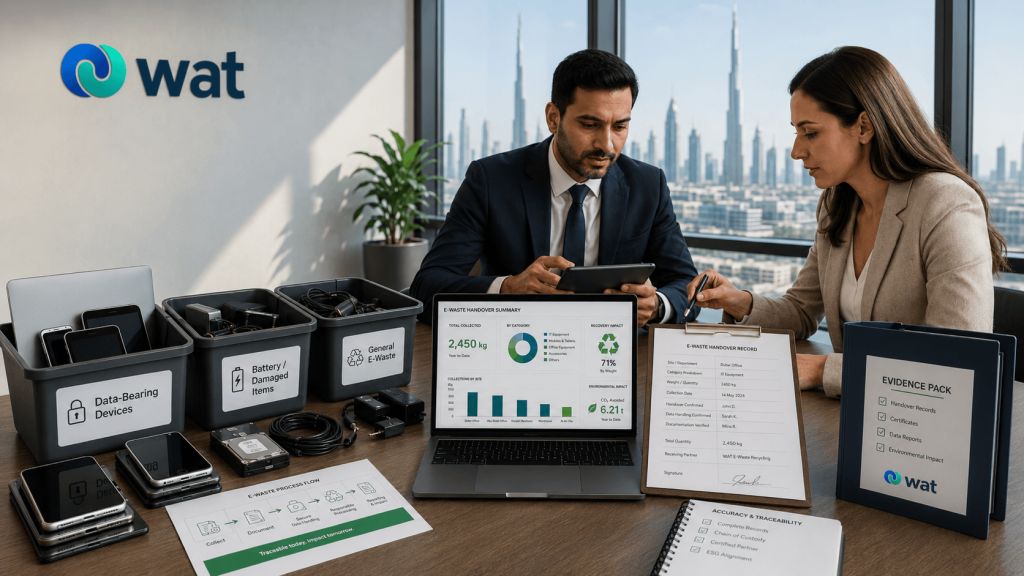
A practical way to keep the process usable is to create one evidence pack for each collection batch.
That pack can include:
- the site or branch details
- the category summary
- condition notes where relevant
- handover record
- related collection documents
- notes for damaged, battery-related, or data-bearing items
- any ESG or impact-related reporting received afterward
This is usually much easier than trying to rebuild a reporting trail months later from emails, spreadsheets, and separate site notes.
Where a digital tracking and reporting platform is being used, these evidence packs can be easier to organize, retrieve, and compare across batches. That gives businesses a more reliable way to keep track of e-waste activity without rebuilding the reporting trail manually each time.
8) Turn one-off collections into a reporting pattern
One collection is useful. A consistent reporting pattern is much more powerful.
Over time, businesses should be able to summarize:
- how many batches were handled in a period
- how many sites participated
- what categories appeared most often
- whether records were consistent across locations
- whether special-handling items were being identified properly
- whether the organization improved its own process over time
This is where ESG evidence becomes more meaningful. It stops being a single operational event and becomes part of a wider management practice.
What makes e-waste evidence stronger
Not all reporting evidence carries the same weight.
The strongest evidence is usually:
- consistent across locations
- easy to retrieve later
- clear on dates, categories, and sites
- linked to handover records
- supported by downstream handling records where needed
- comparable across more than one batch or reporting period
The weaker version is usually vague:
- “we disposed of a lot of electronics”
- “the office was cleared out”
- “old IT equipment was collected”
- “devices were removed during the move”
Those statements may be true. But they do not create strong reporting value on their own.
What not to rely on for reporting
A few things look useful at first, but usually are not enough on their own:
- verbal confirmation that items were removed
- mixed boxes with no category breakdown
- site memories instead of recorded dates
- one-off photos without batch details
- collection activity that cannot be tied to a site or time period
- undocumented assumptions about what happened after pickup
If the business wants reporting evidence, it needs something more structured than that.
Where this supports broader ESG goals
For many organizations, e-waste reporting is not only about disposal. It supports wider ESG goals such as:
- better operational governance
- clearer internal controls
- more consistent treatment of workplace electronics
- better visibility across multiple locations
- stronger sustainability reporting inputs
- more credible internal and external communication
For a broader sustainability angle on how recovered electronics fit into a wider environmental context, see our blog:
Circular Economy in the UAE: How Recovered Electronics Are Fueling the Green Tech Transition.
Common mistakes businesses can avoid
Treating collection activity as evidence by itself
The activity matters, but the reporting value comes from the records behind it.
Letting each site record different information
This makes later comparison and aggregation much harder.
Ignoring damaged or battery-related categories in the reporting trail
Special categories should still be visible in the documentation.
Keeping operational and ESG records completely separate
The best reporting evidence usually comes from strengthening the operational records, not duplicating them later.
Waiting until year-end to assemble the story
The longer the gap, the weaker and harder the reporting trail becomes.
FAQs
What is the simplest way to turn e-waste activity into ESG evidence?
Use the same minimum documentation fields for every batch, keep the handover records, and organize the files so the business can retrieve them later.
Do we need a detailed report for every collection?
Not necessarily. Most businesses can start with a consistent batch record and a simple evidence pack.
What should be recorded for ESG purposes?
At minimum: site, date, category summary, special-handling notes where relevant, and handover details.
Why does documentation matter so much?
Because without clear records, the business cannot reliably show what happened, where it happened, and whether the process was controlled.
Can this work across multiple sites?
Yes. In fact, standardization matters even more for multi-location businesses because reporting becomes much harder when every site uses a different method.
CTA
If your business wants to turn e-waste activity into stronger ESG reporting evidence, WAT can help support collection planning, documentation, secure downstream handling, and reporting-ready batch management. Our digital platform can also help businesses keep track of e-waste activity records more consistently and with better visibility when reporting is needed. Request a collection or contact WAT to discuss your next reporting cycle or retirement batch.