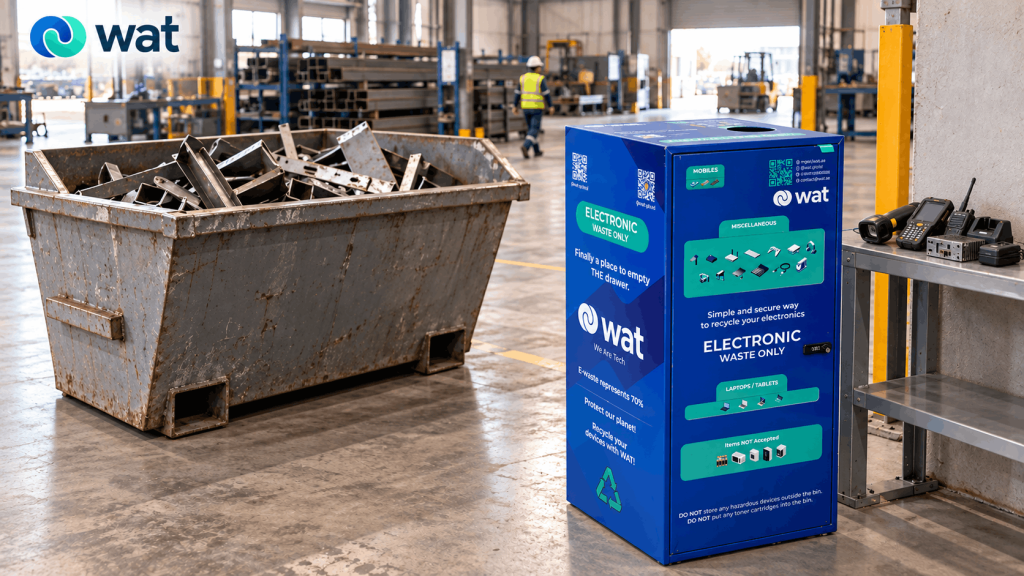
Industrial sites often handle many waste streams at the same time.
There may be steel scrap from maintenance work, packaging waste from operations, damaged tools from the workshop, old machines from production areas, cables from fit-outs, and retired electronics from warehouses, control rooms, offices, and site operations.
When everything is moving quickly, it is easy for electronics to be treated like ordinary scrap.
A scanner goes into a general metal bin. A damaged cable is thrown into mixed waste. A control panel removed during an upgrade is left beside steel parts. Chargers, power supplies, handheld devices, small batteries, sensors, tablets, access devices, and old office electronics end up in the same area as metal, tools, spare parts, and general site clutter.
That is where industrial e-waste bins become useful.
A dedicated e-waste bin gives industrial teams a clear place to separate electronics from steel scrap, general waste, and maintenance leftovers before the batch becomes mixed, hard to count, and harder to hand over responsibly.
This guide is for UAE industrial sites, fabrication yards, workshops, warehouses, maintenance teams, factories, and steel-related businesses that want a cleaner way to separate electronic waste at the source.
Why electronics should not be mixed with steel scrap
Steel scrap and electronics are not the same waste stream.
Steel offcuts, metal parts, brackets, frames, and fabrication waste may look similar to some electronic items at first glance, especially when electronics have metal casings or mounts. But electronic equipment can include circuit boards, batteries, wiring, screens, storage media, plastic components, sensors, ports, embedded chips, and power units.
That means electronics should not disappear into general scrap piles without review.
When electronics are mixed with steel scrap, industrial teams lose visibility over:
- what electronic items were removed from service
- which items may contain batteries or damaged components
- which devices may still hold settings, data, or business-linked information
- what should be repaired, reused, removed, or recycled
- which equipment needs a more controlled handover route
The point is not that every electronic item is high-risk. The point is that mixed scrap makes it harder to tell the difference.
Separate e-waste bins help industrial teams keep that difference visible.
What industrial e-waste can look like on site
Industrial e-waste is not only old laptops or office desktops.
On industrial and steel-related sites, it may include items from operations, maintenance, warehousing, security, production, and administration.
- barcode scanners and handheld devices
- label printers and small site printers
- chargers, docks, adapters, and power supplies
- cables, access devices, and small electronic accessories
- tablets or rugged mobile devices used on site
- old phones, radios, and communication devices
- HMI screens, small control panels, and operator-interface electronics
- sensors, meters, small modules, and removed support electronics
- UPS units, power banks, and battery-containing equipment
- office electronics from admin areas, reception, and control rooms
Some of these items may be small. Some may look like operational tools. Some may sit beside metal parts or machinery components for months. But once they are no longer useful, they should have a separate e-waste route rather than being treated as ordinary site scrap.
For a related look at the operational devices that often get missed in warehouses and industrial facilities, see our blog:
The Hidden E-Waste in Warehouses and Industrial Sites: Scanners, Printers, Handhelds, HMIs, and Control Panels.
Why separate e-waste bins help industrial teams
A separate e-waste bin is a simple control point.
It does not solve every downstream issue by itself, but it makes the first step clearer for employees, maintenance teams, operations staff, and site supervisors.
Instead of asking every person to decide where each electronic item should go, the site creates one visible instruction: electronics go into the e-waste stream, not into steel scrap or general waste.
That helps the site:
- separate electronics before they become mixed with metal scrap
- reduce clutter in maintenance rooms and spare-parts areas
- make small devices and accessories easier to collect
- identify battery-powered or damaged items earlier
- support cleaner category-based handover records
- make responsible disposal easier for workers to follow
The bin is not only about disposal. It is about making the correct behavior easier.
Where industrial sites should place e-waste bins
Placement matters on an industrial site because waste is often generated across multiple zones.
If the e-waste bin is hidden in an admin office, maintenance teams may not use it. If it is placed beside a regular scrap area without signage, items may still be mixed incorrectly.
Useful locations can include:
- maintenance rooms
- workshop exits
- warehouse admin points
- printer and label station areas
- charging stations for handheld devices or tools
- IT or operations rooms
- security or access-control rooms
- near controlled staging areas before pickup
- site office areas where small electronics are commonly replaced
The best location is usually the one where employees already encounter retired or damaged electronics. The bin should be visible, labeled, and clearly separated from metal scrap and general waste bins.
What should be kept out of regular scrap bins
Industrial teams do not need a complex rulebook to start. A simple rule works well:
If the item has a circuit board, battery, plug, charger, screen, data port, sensor, storage component, or electronic control function, it should be reviewed before it goes into a general scrap stream.
Examples that should move through a separate e-waste route include:
- handheld scanners and rugged devices
- control panels and interface screens
- power supplies, adapters, and charging docks
- cables attached to electronic equipment
- portable battery-powered tools or devices that are being retired
- UPS units and backup power equipment
- small office electronics from site admin areas
- electronic modules removed from machinery or site systems
Some parts of industrial equipment may be mechanical or metal-only. Those can follow the site’s normal scrap process. The important point is to separate electronics first, rather than letting electronic components disappear into a mixed pile.
Battery-powered items need extra attention
Many industrial and warehouse devices are battery-powered.
Handheld scanners, radios, rugged tablets, power banks, backup units, and cordless equipment can all contain batteries. If these items are damaged, swollen, heat-affected, or stored poorly, they should not be treated like routine mixed waste.
A practical site rule is:
- keep battery-containing items separate from general accessories
- do not crush or compact old battery-powered devices
- do not stack heavy scrap over devices that may contain batteries
- keep damaged or swollen items isolated and clearly labeled
- avoid storing battery-related items near heat sources or heavy machinery traffic
For a more detailed workplace guide, see our blog:
Lithium-Ion Batteries in the Workplace: Safe Storage & Disposal in the UAE.
Do not treat operational electronics as usual waste
One common mistake on industrial sites is assuming that small operational electronics are low-risk because they are not office computers.
A handheld scanner, access device, site tablet, control interface, label printer, or small module may still be linked to operational workflows, configurations, asset records, user access, or internal process information depending on how it was used.
That does not mean every device needs the same handling path. But it does mean site teams should avoid casual disposal when the item was part of business operations.
A safe working rule is:
if the device was used in operations, check whether it needs data removal, secure handling, or controlled handover before it leaves the site.
The practical workflow for industrial e-waste bins
1) Identify the site zones where electronics build up
Start by walking the site, not just reviewing an office list.
Check maintenance rooms, workshops, charging points, control rooms, warehouse desks, security areas, spare-parts rooms, and admin offices. These are the places where small electronics usually accumulate quietly.
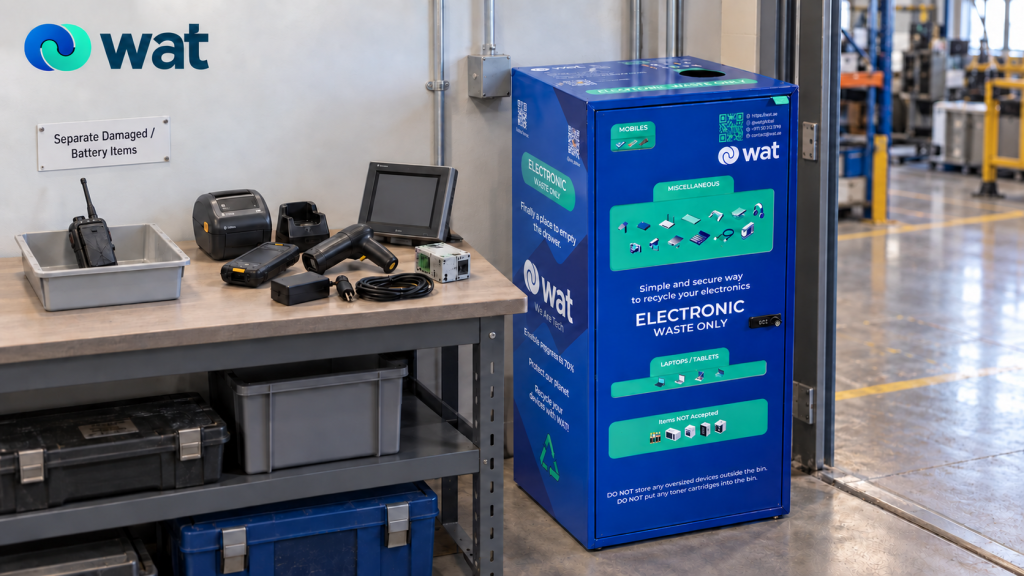
2) Separate e-waste bins from steel scrap and general waste
The e-waste bin should not sit inside a general scrap pile. It should be clearly marked and physically separate enough that workers do not confuse it with metal, packaging, or ordinary waste.
Where relevant, use WAT’s bin visuals or signage so the collection point is easy to recognize.
3) Use simple signage
Signage should make the process easy to follow.
For example:
- Electronics only
- No general waste
- No steel scrap
- Separate damaged or battery-concern items
- Ask site supervisor before placing data-bearing devices
Clear signs prevent the bin from becoming another mixed-waste container.
4) Create a separate lane for damaged or battery-concern items
Do not let damaged items disappear into the same bin without review.
If an item is swollen, leaking, crushed, heat-affected, or visibly damaged, it should be isolated and escalated internally to the appropriate site owner before being moved further.
For a practical guide on damaged devices before pickup, see our blog:
Damaged Electronics in UAE Offices: What to Do with Broken Screens, Swollen Batteries, and Non-Working Devices Before Pickup.
5) Group items before handover
A bin can collect items, but the handover should still be organized.
Before collection, group the batch where practical into categories such as:
- small electronics and accessories
- chargers, docks, and adapters
- handheld devices and scanners
- control panels and operational electronics
- battery-containing devices
- damaged or attention-needed items
This makes counting easier and gives the receiving team a cleaner view of the batch.
6) Keep a simple handover record
Industrial teams do not need to overcomplicate the recordkeeping, but they should avoid anonymous handovers.
At minimum, keep:
- site name
- collection date
- collection point or zone
- main item categories
- approximate quantities
- notes for batteries, damaged items, or data-bearing devices
- site contact and receiving party
A simple batch record is much better than a mixed pile with no clear owner.
For larger site clear-outs where the batch spans multiple areas or teams, see our blog:
How UAE Companies Can Prepare for a Large-Volume E-Waste Collection.
What good separation looks like
A good industrial e-waste setup usually looks like this:
- steel scrap stays in the metal scrap stream
- general waste stays out of the e-waste bin
- electronics have a dedicated, clearly marked collection point
- battery-containing and damaged items are flagged separately
- operational electronics are reviewed before handover
- bins are checked regularly and do not overflow
- the collection batch is grouped by category before pickup
- the site keeps a basic record of what was handed over
This is not a complicated system. It is a practical way to stop electronics from being treated like ordinary scrap.
Common mistakes industrial sites can avoid
Putting electronics into steel scrap bins
This makes it harder to identify batteries, circuit boards, data-bearing devices, and special-handling items.
Using one mixed bin for everything
A mixed bin may look convenient, but it creates sorting problems later.
Ignoring small accessories
Chargers, adapters, cables, docks, and modules may not look important individually, but they build up quickly.
Forgetting battery-powered devices
Scanners, tools, radios, tablets, and backup power units may need a more careful route than general site waste.
Leaving old electronics in maintenance rooms
If there is no visible collection point, retired electronics often become long-term clutter.
FAQs
Do industrial sites need separate e-waste bins?
Yes. Separate e-waste bins help industrial sites keep electronics away from steel scrap, general waste, and mixed maintenance clutter.
Can electronics go into steel scrap bins?
Electronics should be reviewed and separated before they enter a scrap stream. Items with circuit boards, batteries, plugs, sensors, screens, or control functions should move through an e-waste route instead of being treated as ordinary steel scrap.
What types of industrial electronics should be separated?
Common examples include handheld scanners, label printers, chargers, docks, adapters, control panels, HMI screens, electronic modules, UPS units, tablets, phones, and battery-powered site devices.
Should damaged or battery-powered items go into the same e-waste bin?
Damaged, swollen, leaking, crushed, or heat-affected items should be separated and clearly labeled. Routine electronics and attention-needed battery items should not be treated exactly the same.
Is this only for factories and steel businesses?
No. The same approach can help warehouses, workshops, logistics sites, fabrication yards, maintenance teams, and any industrial location where electronics are at risk of being mixed with scrap or general waste.
If your industrial site, workshop, warehouse, or steel-related facility has old electronics, chargers, scanners, control panels, cables, or battery-powered devices building up beside scrap and general waste, WAT can help you create a more controlled e-waste collection path. Request an e-waste collection or contact WAT to discuss separate e-waste bins and responsible handover for your UAE site.