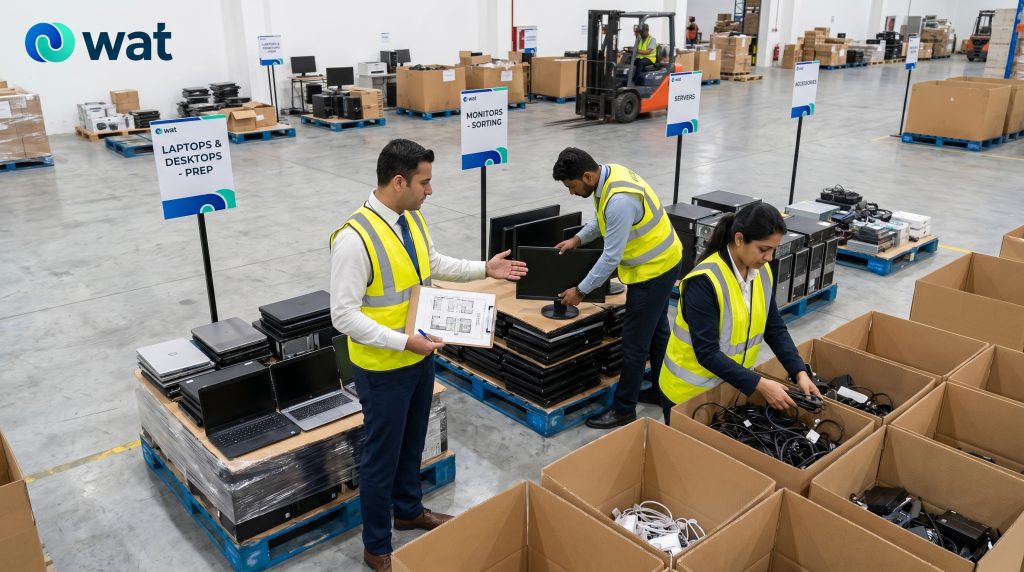
A large-volume e-waste collection is not just a pickup date on the calendar.
Once the batch moves beyond a few retired laptops or a small office cleanout, the job changes. Devices may be spread across departments, floors, technical rooms, storage areas, branches, or back-office spaces. Some items may be data-bearing. Some may be damaged. Some may still be mixed with active equipment, accessories, packaging, or general storage.
If internal teams are not aligned before collection day, the result is usually the same: slower loading, last-minute sorting, confusion over what is included, and weaker handover records than the business expected.
That is why large-volume collections work best when they are treated as a short internal project rather than a last-minute removal task.
For UAE businesses, these collections often happen during office refreshes, relocations, floor consolidations, branch closures, warehouse clear-outs, infrastructure upgrades, or periodic end-of-life cleanup cycles. In each case, the goal is the same: prepare the batch properly so the handover is clean, controlled, and easy to manage.
This guide is a practical approach to preparing for a large-volume e-waste collection in the UAE, with a focus on internal teams, site readiness, and vendor coordination.
Why large-volume collections need more structure
A small batch can sometimes be managed informally. A larger one usually cannot.
Once the volume grows, predictable issues start to appear:
- devices are spread across multiple locations
- departments package items differently
- retired and active equipment get mixed together
- damaged items or battery-containing devices are not separated properly
- site teams are unclear on what should be ready before pickup
- collection-day access or loading logistics are not fully thought through
- handover records become incomplete
Most of the time, the problem is not that the collection fails. The problem is that it becomes slower, messier, and harder to document than it needed to be.
A little preparation solves most of that.
What counts as a large-volume e-waste collection
There is no single item count that makes a batch “large-volume.”
In practice, it becomes a large-volume collection when one or more of these conditions apply:
- the batch spans multiple rooms, departments, or floors
- the collection includes mixed device categories
- the site needs temporary staging before pickup
- more than one internal team is involved
- damaged or battery-related items are included
- the collection must be coordinated around building access, lifts, loading bays, or operations windows
So the issue is not only how much equipment there is. It is how much coordination the handover requires.
What should be agreed before the collection is scheduled
Before a date is confirmed, the business should agree on the planning scope.
That usually includes:
- what categories are part of the batch
- what is not part of the batch
- which site areas are included
- who owns the process internally
- whether the batch includes damaged or battery-containing items
- whether data-bearing devices need a defined downstream path
- what loading route and handover point will be used
This prevents a common problem: different teams preparing different versions of the batch.
The practical preparation workflow

1) Assign one internal owner for the collection
The first step is simple but important: one person or one role should own the collection project internally.
That person does not need to do everything. But they should coordinate:
- internal deadlines
- site readiness checks
- communication between departments
- vendor coordination
- the final handover point
Depending on the organization, this role may sit with IT, facilities, office management, operations, or a project lead.
What matters is that there is one visible owner rather than a general assumption that “someone is handling it.”
2) Identify which internal teams need to be involved
A large-volume collection usually touches more than one function.
Typical internal stakeholders include:
- IT — confirms what is being retired and whether any devices need a specific data-handling route
- Facilities / operations — manages staging areas, internal movement, loading paths, and collection-day access
- Admin / office management — helps coordinate instructions across departments
- Security — supports access control where restricted entry, service lifts, or escorted collection routes apply
- Procurement or finance — may need visibility where tracked assets, leased equipment, or controlled records are involved
Not every site will need all of these teams equally. But the larger the batch, the more important early alignment becomes.
3) Set a clear cutoff date for adding items to the batch
This step is often missed.
For large collections, set an internal cutoff date after which new devices should not be added casually to the batch unless the owner approves it. Without that cutoff, the collection list keeps changing, staging becomes less accurate, and collection-day counts become harder to control.
A simple rule works well:
after the cutoff date, only pre-approved additions should go into the staged batch.
That one step makes the handover much cleaner.
4) Build a simple pre-collection inventory by area
You do not need a perfect asset register for a large-volume collection. You do need enough structure to know what is being handed over.
A practical inventory should include:
- site name
- floor, room, or department
- device category
- quantity
- condition
- notes for damaged items, battery-powered items, or storage devices
For larger offices or multi-zone sites, grouping by area is much more useful than trying to treat the whole batch as one undifferentiated pile.
The aim is not perfect documentation. The aim is to stop the collection from becoming anonymous.
5) Separate active equipment from retired equipment early
This is one of the most useful control steps in the whole process.
If retired devices are stored too close to active equipment, mistakes happen. Teams move the wrong monitor, take the wrong dock, leave a device in the retirement pile that was meant to stay in service, or remove something that was still needed.
Use a simple rule:
if it is staying in service, it should not be staged anywhere near the retirement batch.
This matters most during phased refresh projects, relocations, and floor-by-floor consolidations.
6) Stage the batch before collection day
A large-volume pickup should not begin with the collection team searching the site for devices.
Before the collection day, move the batch into a controlled staging area wherever practical.
A good staging area should be:
- easy to control
- clearly labeled
- close enough to the loading route to reduce unnecessary rehandling
- large enough for category-based grouping
- separate from active work zones and general storage clutter
If your team needs a more detailed framework for the storage step, see our blog:
Retired IT Assets in UAE Offices: How to Store Devices Securely Before Pickup (Physical Security + Labeling + Access Control).
7) Group the batch by category before handover
Do not present one mixed pile if the batch includes multiple device types.
Use separate groups for:
- laptops and desktops
- monitors
- phones and tablets
- printers and multifunction devices
- servers and network equipment
- handheld devices and scanners
- cables, docks, and adapters
- battery-containing devices
- damaged or special-handling items
This makes collection-day loading faster and makes the handover record far easier to keep accurate.
8) Separate damaged and battery-containing items clearly
Damaged devices and battery-powered items should never be treated as an afterthought in a large-volume batch.
Broken screens, visibly damaged devices, swollen batteries, heat-affected units, and compromised battery-containing equipment should be grouped separately and labeled clearly before collection day.
That matters because these items affect:
- how the staging area is organized
- how the vendor prepares for collection
- how the handover record is written
For a practical guide on handling these items before pickup, see our blog:
Damaged Electronics in UAE Offices: What to Do with Broken Screens, Swollen Batteries, and Non-Working Devices Before Pickup.
9) Confirm the data-handling path before the batch leaves the site
If the collection includes data-bearing devices, the handling path should already be clear before pickup.
That may include:
- data sanitization
- hard disk shredding
- asset destruction
- another approved internal route depending on policy and device condition
The important point is that collection planning should not be separated from downstream handling. If the organization may later need to answer what was handed over, when it left the site, and under what controls, those decisions should be defined early.
For a practical guide to documenting those transfer points, see our blog:
Chain of Custody for Retired IT Assets in the UAE: Why Documentation Matters from Pickup to Final Processing.
10) Coordinate the vendor with real site details
Vendor coordination should include more than “please collect on this date.”
Before the collection happens, confirm practical details such as:
- site address and access route
- loading bay or service entrance
- lift access or floor restrictions
- preferred collection window
- whether the batch is fully staged
- whether damaged or battery-related items are included
- whether large printers, racks, or heavy equipment are part of the batch
- who the site contact will be on the day
These details reduce surprises and help the collection run to plan.
11) Decide who will be present on collection day
A large-volume handover goes more smoothly when the right people are present.
At minimum, collection day should have:
- the internal collection owner or delegate
- a site contact who can release the batch
- access support where the building requires it
- the receiving party handling the collection
This prevents delays at the final stage, especially where the building has access restrictions or the batch is spread across more than one staging point.
12) Prepare a simple handover record
Even if the site is not using a complex system, a large-volume collection should still have a clean handover record.
At minimum, include:
- collection date
- site name
- category totals
- notes for damaged or battery-related items
- releasing contact
- receiving party
- batch reference if used internally
That is usually enough to support traceability without creating unnecessary admin.
Common mistakes teams can avoid
Waiting until collection day to sort the batch
Sorting on the day is slower, less accurate, and more stressful than doing it in advance.
Mixing active and retired equipment
This is one of the fastest ways to create avoidable mistakes.
Using uncontrolled storage areas for a large batch
If the staging area is open, messy, or shared with unrelated stock, visibility drops quickly.
Forgetting the cutoff date
If items keep getting added at the last minute, the batch becomes harder to count and harder to hand over cleanly.
Not telling the vendor enough about the site
Access, loading, timing, and special-handling details matter more than teams often expect.
Skipping the handover record
Even a simple batch record is much better than no record at all.
FAQs
What makes an e-waste collection “large-volume”?
Usually the level of coordination matters more than the exact item count. If the batch spans multiple areas, categories, or internal teams, it should be treated as a large-volume collection.
Should everything be staged before the collection team arrives?
As far as practical, yes. A staged batch makes the handover faster, cleaner, and easier to document.
Do damaged devices need to be separated from the main batch?
Yes. Damaged or battery-related items should be grouped and noted clearly before collection.
What should the vendor know before arriving?
At minimum: site access details, loading arrangements, collection window, site contact, whether the batch is staged, and whether any special-handling items are included.
Do we need a detailed inventory for every accessory?
Not always. A practical category-based inventory is usually enough for larger mixed batches.
If your business is preparing for a large-volume e-waste collection and wants a more controlled process around internal coordination, site readiness, and structured handover, WAT can help you plan the collection properly from the start. Request a collection or contact WAT to coordinate the next batch.