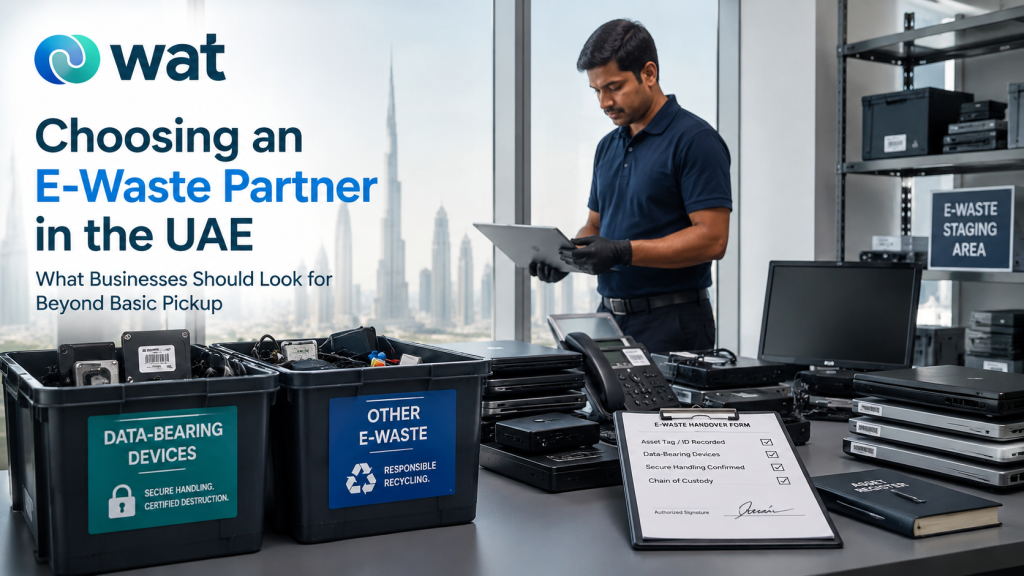
For many businesses, the first question sounds simple:
Can someone collect our old electronics?
But once retired laptops, desktops, monitors, phones, servers, printers, handhelds, storage devices, and other workplace electronics are actually ready to leave the site, the question changes.
It is no longer just about pickup.
It becomes a question of control, documentation, data handling, internal coordination, and what happens after the equipment leaves your premises. A provider may be easy to contact, easy to book, and easy to schedule. That does not automatically mean they are the right partner for a business that needs structured handover, clear records, and a more disciplined approach to retired IT assets.
That is why choosing an e-waste partner should not be treated as a transport decision alone.
For UAE businesses, the better question is:
What should we look for beyond basic pickup?
This guide is for UAE companies that want a more practical way to evaluate an e-waste partner, especially when the batch includes business devices, data-bearing assets, multiple departments, or ongoing retirement needs rather than a one-time cleanup.
Why basic pickup is not enough
If the only goal is “remove these boxes from the office,” almost any collection can look good enough.
But that is rarely the real requirement for a business.
Most organizations need more than collection. They need a partner that can support a controlled process before pickup, during handover, and after the batch leaves the site. That usually includes questions such as:
- Can the provider handle mixed business electronics properly?
- Can they support a defined route for data-bearing devices?
- Can they work with site restrictions and internal coordination?
- Can they help keep the handover documented and structured?
- Can they handle damaged or battery-containing items properly?
- Can they support repeatable collections across more than one batch or site?
These are the questions that separate a basic pickup service from an actual e-waste partner.
What businesses often get wrong when choosing a partner
A lot of vendor selection issues start with the wrong evaluation criteria.
Businesses often compare providers based on:
- how quickly they reply
- whether they can collect this week
- whether they will “take everything”
- whether the collection sounds simple
Those points are not irrelevant. But they are not enough.
A partner may be easy to schedule and still be a poor fit for a company that needs controlled staging, documentation, secure handling of data-bearing devices, or clean coordination across internal teams.
The stronger evaluation method is to look at how the provider supports the full process, not just the pickup event.
What “beyond basic pickup” actually means
In practical terms, it means looking at the provider through five lenses:
- operational fit
- data-handling capability
- documentation and traceability
- site coordination
- consistency over time
If a provider is weak in those areas, the collection may still happen, but the business may be left with gaps before or after the handover.
The practical evaluation framework businesses can use
1) Start with your own needs first
Before comparing providers, define what your business actually needs.
That may include:
- one office or multiple sites
- small periodic batches or large-volume collections
- ordinary office equipment or mixed technical/operational electronics
- standard retired assets or damaged / battery-containing devices
- data-bearing equipment requiring a defined handling path
- simple one-time collection or ongoing retirement support
This matters because the right partner for a one-off clearout may not be the right partner for an organization that needs recurring, documented, business-grade handling.
A vendor selection process works much better when the business is clear about the actual job.
2) Check whether the provider understands business electronics, not just general e-waste
A useful e-waste partner should understand that business electronics are not all the same.
A mixed corporate batch may include:
- laptops and desktops
- servers and storage devices
- monitors and docks
- phones and tablets
- printers and multifunction devices
- network equipment
- scanners, handhelds, and branch devices
- damaged or battery-containing items
- cables, chargers, docks, and accessories
A serious business partner should be comfortable discussing how these categories are grouped, staged, and handed over rather than treating everything as one generic scrap stream.
That is especially important for mixed batches coming from offices, warehouses, branches, technical rooms, or operational sites.
3) Ask how they handle data-bearing devices
This is one of the most important questions in the entire selection process.
If your retired batch includes laptops, desktops, servers, phones, storage devices, removable media, or other business electronics that may hold data, the provider should be able to speak clearly about the downstream handling path.
That may include:
- data sanitization
- hard disk shredding
- asset destruction
- another defined route based on internal policy and device type
The point is not that every device needs the same treatment. The point is that the partner should understand the difference and be able to work with your internal requirements.
For a broader look at why this matters, see our blog:
5 Key Data-Security Risks in IT Asset Disposal (ITAD) for UAE Businesses and How to Mitigate Them.
4) Look for a partner that values documentation, not just removal
A business-grade e-waste partner should not treat documentation as an afterthought.
You do not necessarily need complex paperwork for every batch. But you do need a partner that understands why businesses care about:
- category-based batch visibility
- handover records
- collection dates and site references
- clear transfer points
- records that support internal accountability
This matters because once the equipment leaves your site, the business may still need to answer simple questions later:
- what left the site
- when it left
- who released it
- how the handover was handled
For a practical guide to this side of the process, see our blog:
Chain of Custody for Retired IT Assets in the UAE: Why Documentation Matters from Pickup to Final Processing.
5) Assess whether they can work with real site conditions
A provider can sound capable on paper and still struggle on-site.
That is why site coordination matters.
A good partner should be able to work with practical realities such as:
- building access controls
- service entrances and loading bays
- floor restrictions and lift access
- staged or unstaged batches
- collections in active office environments
- warehouse or industrial locations
- collection windows that need to avoid disruption
This becomes even more important when the job is a large-volume collection rather than a few boxes from one room.
If your business is preparing a large batch, see our blog:
How UAE Companies Can Prepare for a Large-Volume E-Waste Collection: Internal Teams, Site Readiness, and Vendor Coordination.
6) Ask how they expect the site to prepare
A good partner should be able to explain what they need from you before the collection happens.
That usually includes:
- what categories should be grouped separately
- how damaged items should be flagged
- how battery-containing items should be separated
- what site information should be shared in advance
This is a useful test of seriousness.
A provider that can only say “we’ll come and take it” may not be the right fit for a business that wants a more controlled process.
7) Check how they handle damaged and battery-containing items
This is one of the easiest places to spot the difference between a simple collector and a stronger operational partner.
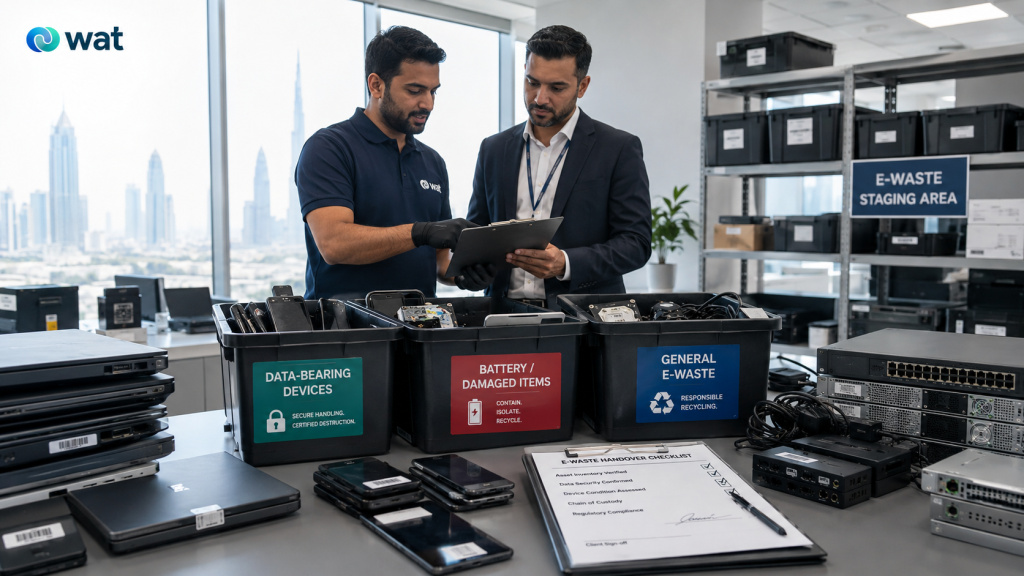
Battery-containing devices, damaged electronics, and visibly compromised items should not be treated as a casual mixed add-on to the batch.
A stronger partner should be comfortable discussing:
- how these items should be separated
- how they should be flagged before collection
- whether they should be staged differently
- how the handover notes should reflect them
That matters for laptops, phones, scanners, handhelds, UPS-related units, and other devices that may contain batteries or show visible damage.
8) Look for clarity, not vague promises
A good e-waste partner does not need to oversell.
In many cases, the strongest sign is clarity.
Look for clear answers to questions like:
- what categories can you handle?
- what do you need from us before pickup?
- how should we prepare the site?
- what happens at handover?
- what if the batch includes damaged or battery-related items?
- what if some items are data-bearing?
- what records will support the collection?
Clear operational answers are usually more useful than general claims about being “full-service” or “eco-friendly.”
9) Evaluate whether they are suitable for one-off jobs and repeatable processes
Some businesses only need a one-time collection.
Others need a partner they can use more than once: after refreshes, branch closures, warehouse upgrades, decommissioning work, or periodic cleanups.
That means the right partner should not only be able to collect once. They should also be suitable for a repeatable internal process.
A useful question is:
Can this provider fit into our ongoing retirement workflow, or are they only convenient for a one-time pickup?
That question often makes the decision much clearer.
10) Choose the partner that reduces internal friction
A strong e-waste partner does not just remove equipment. They make the business’s internal process easier.
That usually means they help reduce:
- confusion between departments
- uncertainty about site preparation
- delays at handover
- mixed or unclear batches
- weak documentation
- last-minute decision-making
The best partner is often the one that helps your internal team stay organized, not just the one that can collect fastest.
Practical questions businesses can ask a provider
If you want a simple shortlisting framework, ask these questions:
- What types of workplace electronics do you commonly handle?
- How should we prepare a mixed business batch before collection?
- How should damaged or battery-containing items be separated?
- Can you support a defined handling path for data-bearing devices?
- What information should we provide before pickup?
- What should our team have ready on collection day?
- How do you help keep the handover clear and documented?
- Can you support larger or repeat collections if needed?
You do not need a long procurement process to ask better questions. But asking the right questions early usually leads to a better partner.
Common mistakes businesses can avoid
Choosing only on speed
A fast response is useful, but it is not enough on its own.
Treating all e-waste providers as interchangeable
The ability to remove electronics is not the same as the ability to support a controlled business process.
Ignoring data-bearing devices until after pickup is booked
The handling path should be clear before the batch leaves the site.
Not checking site-readiness expectations
Collection-day confusion often starts because the site and provider were not aligned in advance.
Overlooking damaged or battery-containing items
These should be discussed before collection, not discovered casually on the day.
FAQs
What is the most important thing to look for in an e-waste partner?
The ability to support a controlled business process, not just basic collection. That includes site readiness, data-related handling, clear handover, and operational coordination.
Should we choose based on price alone?
Price matters, but it should not be the only factor. A lower-cost pickup may still create more internal friction if the process is unclear or poorly coordinated.
Why does documentation matter when choosing a provider?
Because the business may need to know what left the site, when it left, and how the handover was managed.
What if our batch includes servers, storage devices, or other data-bearing assets?
Then the provider should be able to work with a defined handling path rather than treating the whole batch as generic electronics.
Can the same e-waste partner handle offices, warehouses, and branches?
Possibly, but that depends on whether they can work with different site conditions and mixed asset categories in a structured way.
If your business is reviewing e-waste partners and wants more than basic pickup, WAT can help you plan a structured approach to collection, handover, secure downstream handling, and repeatable retirement support. Request a collection or contact WAT to discuss your site and batch requirements.