
It is not the lack of good intentions that creates an e-waste problem for most businesses.
They have an e-waste problem because responsibility is scattered.
Old laptops end up in a store room. Damaged handhelds sit in a drawer. Printers get retired without clear ownership. A server is removed from service, but the handover process is not fully documented. One branch follows one process, another branch follows a different one, and over time the business ends up with a growing pile of retired electronics and no single internal rule for what should happen next.
That is where an e-waste policy becomes useful.
A practical e-waste policy is not a legal document written for a shelf. It is a working internal guide that tells teams what counts as retired electronics, who is responsible, what controls apply, and how devices should move from active use to final handover.
For UAE businesses, that matters because electronic waste handling is no longer something that should be left to informal office cleanups or unstructured storage. A simple internal policy helps the business create consistency, protect sensitive equipment, reduce confusion between teams, and support more responsible disposition. Our service model is already built around the same operational pillars: electronic asset disposition, secure data destruction, recycling, and ESG reporting support.
This guide is for UAE companies that want a practical, business-friendly e-waste policy they can actually use.
Why businesses need an e-waste policy at all
Without a policy, e-waste decisions usually happen one item at a time.
A device breaks, and someone stores it. A department upgrades equipment, and old items are boxed without clear labels. A branch closes, and staff gather electronics into mixed piles. A technical room is cleared, but no one is fully sure what records should be kept or who should approve handover.
That creates predictable problems:
- retired devices stay on site longer than expected
- teams handle similar items in different ways
- data-bearing devices are not always treated consistently
- damaged or battery-containing devices are not separated properly
- handover records become inconsistent
- responsibility sits in a grey area between IT, facilities, admin, procurement, and finance
A policy solves that by creating one internal rule set.
Not a perfect one. Just a clear one.
What an e-waste policy should do
A practical e-waste policy should answer six basic questions:
- what items fall within the policy
- when an item is considered retired
- who owns the process internally
- what controls apply before handover
- how special cases should be handled
- what records should be kept
If the policy covers those six things clearly, it will already be more useful than most informal disposal habits.
What should be included in the policy
The policy does not need to be long to be effective. But it does need to be clear.
1) Scope: what counts as e-waste in your business
Start by defining what the policy covers.
For most UAE businesses, that should include:
- laptops and desktops
- monitors and docking stations
- phones and tablets
- printers and multifunction devices
- servers and storage devices
- network equipment
- POS devices, scanners, handhelds, and branch electronics
- cables, chargers, docks, and accessories where relevant
- damaged or non-working electronics
- battery-containing business devices
This matters because one of the most common policy failures is an overly narrow scope. Teams may think “IT assets” only means laptops and servers, while everything else gets handled informally.
A practical policy should make it clear that retired workplace electronics are not limited to obvious office computers.
2) Definition of retirement: when an item enters the process
The policy should define when a device is considered retired.
A simple rule works well:
An item enters the e-waste process when it is no longer approved for active business use and is awaiting reuse, controlled handover, disposal, recycling, or another approved downstream path.
That matters because businesses often confuse three different stages:
- no longer in use
- in storage
- formally retired and ready for controlled handling
The policy should remove that ambiguity.
3) Roles and ownership: who is responsible
This is one of the most important parts of the whole policy.
The policy should state clearly who owns:
- retirement approval
- internal collection or staging
- data-handling decisions for relevant devices
- storage controls before pickup
- final handover coordination
- record retention
In practice, that often means:
- IT confirms what is leaving service and whether any device needs a specific data-handling path
- Facilities or operations manage staging, access, and handover logistics
- Admin or office management support site coordination
- Procurement or finance may need visibility where tracked assets, leased equipment, or approvals are involved
The policy does not need to make one team do everything. It does need to stop the process from becoming “everyone assumed someone else owned it.”
4) Pre-handover controls: what happens before devices leave the site
A useful policy should explain what minimum controls apply before pickup or transfer.
That usually includes:
- category-based segregation
- clearly labeled staging or storage
- separation of active and retired equipment
- controlled handling for damaged or battery-containing items
- a defined data-handling route for data-bearing assets
- handover only through an approved internal process
This section is what turns the policy from a principle document into an operational one.
5) Special cases: the items that should not be handled casually
A strong policy should call out special categories clearly.
These usually include:
- data-bearing devices
- damaged electronics
- swollen or battery-compromised devices
- loose drives or storage media
- provider-owned or leased equipment
- equipment removed during relocations, fit-outs, or decommissioning work
- mixed branch or multi-site batches
This matters because teams are usually good at handling straightforward items. Problems happen in the exceptions.
For a broader look at why controlled handling matters for data-bearing devices, see our blog:
5 Key Data-Security Risks in IT Asset Disposal (ITAD) for UAE Businesses and How to Mitigate Them.
Our published piece already highlights the risks created when retired equipment is stored loosely, moved without clear handover controls, or handled without enough visibility.
6) Documentation: what records the policy requires
An e-waste policy should be clear about documentation without becoming paperwork-heavy.
At minimum, the policy can require:
- site or department name
- device categories
- quantities
- condition notes where relevant
- notes for damaged or battery-related items
- internal owner or releasing contact
- receiving party at handover
- date of collection or transfer
- batch reference if used internally
That is usually enough for most businesses to create practical traceability.
If the business wants stronger internal controls, it can add asset identifiers for higher-control or data-bearing equipment.
Who should own the policy
The policy should have one accountable owner, even if several teams use it.
In many businesses, the best owner is not necessarily legal or compliant. It is often one of these:
- IT
- facilities / operations
- office management
- ESG / sustainability lead in larger organizations
- procurement or governance lead where asset control is more formal
The right owner is usually the function that can keep the policy active, not the function that can merely approve it once.
A practical approach is:
- one policy owner
- several process contributors
- clear sign-off roles where needed
That structure is usually easier to maintain than a policy “owned by everyone.”
What a simple policy structure can look like
A business does not need a 20-page policy to make progress.
A clean internal policy can be built around these sections:
- Purpose
- Scope
- Definitions
- Roles and responsibilities
- Retirement and staging process
- Handling of data-bearing devices
- Handling of damaged and battery-containing items
- Handover and documentation requirements
- Approved external handling pathway
- Review and update responsibility
That is enough structure for most organizations.
How to roll the policy out across the business
A policy only works if people use it.
That means rollout matters almost as much as the wording.
1) Start with the teams that actually touch retired devices
The first rollout group is usually not senior management. It is the teams that deal with the hardware in real life.
That often means:
- IT
- facilities
- admin
- operations
- warehouse or branch supervisors
- security where relevant
These are the teams that need the process to be clear and practical.
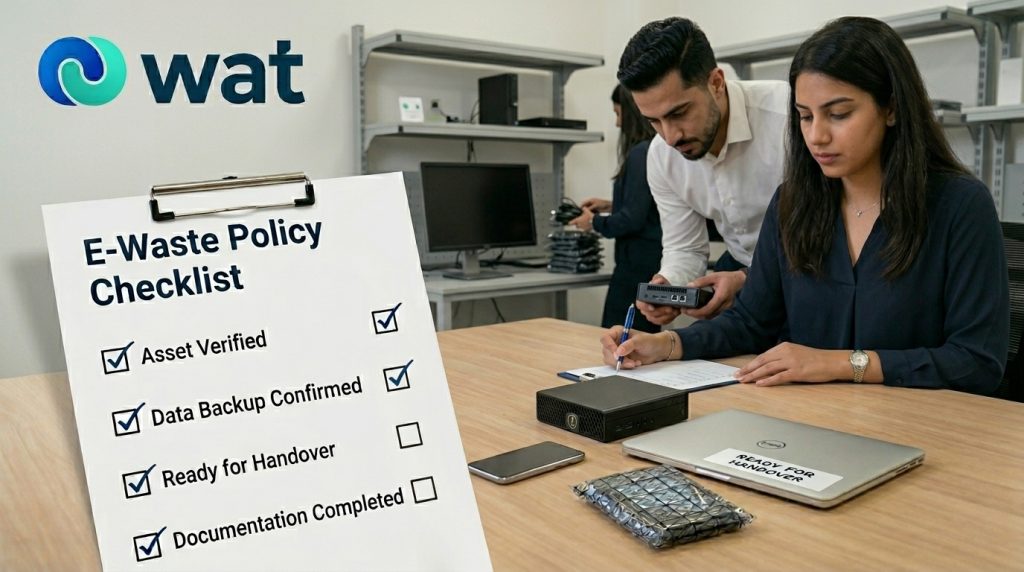
2) Use one checklist alongside the policy
Policies become easier to follow when they are supported by a short operational checklist.
For example:
- Is the item retired from active use?
- Is it in scope under the policy?
- Has it been grouped correctly?
- Is it damaged or battery-containing?
- Does it need a data-handling decision?
- Has it been moved to the approved staging area?
- Is the handover being documented?
A checklist helps the policy become repeatable.
3) Apply the same policy across branches and sites
If the business has multiple locations, one of the most useful things the policy can do is create consistency.
The policy should not leave every site to invent its own retirement method. It should give all branches a shared baseline, even if collection logistics differ by site.
That is especially important for:
- retail sites
- hospitality locations
- warehouses
- multi-floor offices
- companies with both offices and operational locations
4) Review it after the first few real batches
The best time to improve an e-waste policy is after it has been used, not before.
After the first few collection or retirement cycles, ask:
- Where did confusion still happen?
- Which roles were unclear?
- Did staging work properly?
- Were damaged items handled consistently?
- Did the documentation stay simple enough?
- Did the process work across all sites?
That review makes the policy practical rather than theoretical.
Common mistakes businesses can avoid
Writing a policy that is too broad and too vague
If the policy says only “dispose of e-waste responsibly,” teams will still be left guessing.
Making the policy too legalistic
A practical workplace policy is easier to follow than a document written in abstract compliance language.
Forgetting non-IT operational electronics
Scanners, handhelds, POS devices, and other site electronics should not be left outside scope.
Leaving ownership unclear
If no one owns the process, the policy becomes a document rather than a working rule.
Ignoring damaged and battery-related items
These should be explicitly addressed, not left for teams to improvise.
Rolling it out without a checklist
People follow processes more reliably when there is a short working checklist behind the policy.
How this fits with broader UAE business practice
For UAE businesses, a practical e-waste policy is not only about internal organization. It also supports a more disciplined approach to waste handling, sustainability, and responsible downstream management in a market where waste-management expectations are becoming more structured. Federal integrated-waste legislation aims to unify proper disposal mechanisms and best practices, while Dubai’s current waste-management law emphasizes minimising waste and promoting sustainable resource use. Our own service model also reflects that wider direction by combining disposition, secure data removal, recycling, and ESG reporting support.
For a broader UAE context on producer responsibility and the direction of policy change, see our blog:
How the UAE’s Extended Producer Responsibility (EPR) Rules Will Impact Corporate E-Waste Management.
Our published article already explains that EPR is becoming a more visible part of the national conversation around environmental responsibility and long-term waste reduction.
FAQs
What is the main purpose of an e-waste policy?
To create one internal rule set for how retired electronics are identified, controlled, stored, handed over, and documented.
Who should own an e-waste policy inside a company?
Usually the team is best placed to keep the process active, such as IT, facilities, operations, office management, or a governance lead.
Does the policy need to cover more than laptops and desktops?
Yes. A useful policy should also cover printers, phones, servers, scanners, handhelds, accessories, battery-containing devices, and other workplace electronics that can otherwise slip into informal storage or disposal.
Should damaged and battery-containing devices be handled separately in the policy?
Yes. They should be called out explicitly so teams do not improvise when those items appear in retirement batches.
How long does an e-waste policy need to be?
Not very long. A short, clear, workable policy is usually better than a long document that teams never apply.
If your business wants to move from ad hoc device disposal to a more controlled internal process, WAT can help you support collection planning, secure downstream handling, and a more consistent approach to e-waste management. Request a collection or contact WAT to discuss your next retirement batch.